6" Round Fieldstone Tower Building Instructions
|
This page contains instructions on how to use mold #73 to build the round fieldstone tower. You will have to cast the mold 26 times to build the tower in the large photo. I know that sounds like a lot of castings but this is a big tower. |
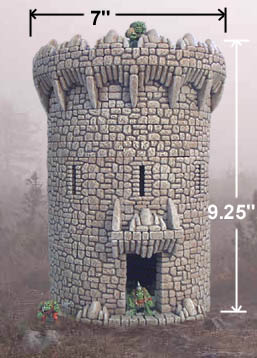
| |
|
If you want to build the tower with the conical roof, you will need 30 castings of mold #73 instead. You will also need 12 castings of mold #86 for the roof. |

| |
About Mold #73
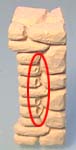
| 1. | Some of the pieces on this mold (such as the arrow slits) are difficult to cast without air bubbles in the pieces. The best method of casting these pieces is to use the "wet water" method shown on the Advanced Casting Instructions page. Using this method, most of the air bubbles will be eliminated giving you nearly perfect castings. |
 |
|---|
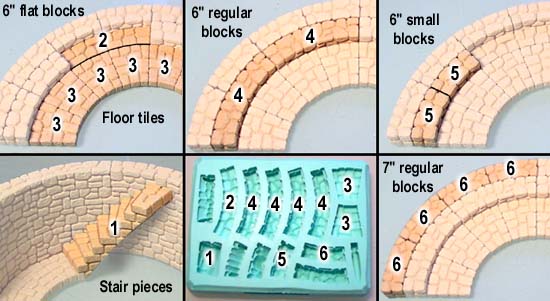
| 2. | Now to describe the pieces on this mold. Connect the numbers on the mold to the numbers on the blocks. This will show you which pocket in the mold will make certain blocks. |
 |
|---|
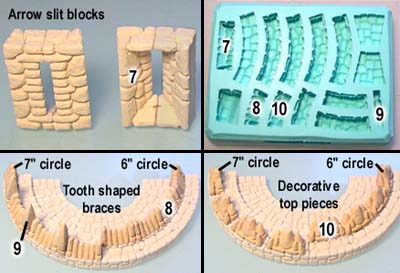
| 3. | This photo shows the location of the arrow slit block and decorative pieces. The decorative teeth braces can be placed a couple of ways. You can place 4 of them on a section of the 6" wall, or you can place 4 of them with the large decorative teeth in between on a 7" wall. The top crenellations can be spaced apart whatever distance you want on either diameter of wall. |
 |
|---|
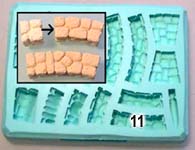
| 4. | The last piece shown is the transition piece. You could make this piece yourself by gluing a curved block to a square block, but you would have a seam down the middle. |
 |
 |
|---|
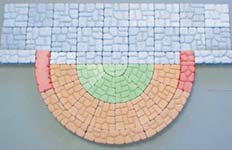
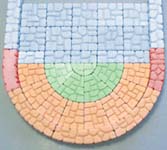
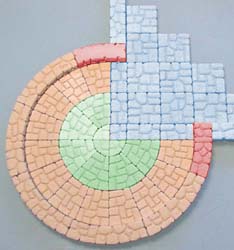
| 5. | This transition piece allows you to attach a curved wall to a straight wall with no obvious seams. The blocks shown in red are the transition blocks. The blocks shown in blue are from mold #70 and #260. The blocks shown in green are from mold #72. You'll have to flip one of the transition blocks upside down to get this to work. You won't see it because the next layer of blocks will alternate with regular circular and straight blocks. |
|
 |
|---|
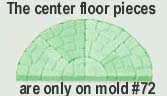
| 6. | I'm sure some of you will be disappointed that the center floor tiles (shown in green) were not on this mold. I really tried, but there was no extra space on the mold for them. I could have dropped some of the other decorative pieces, but then the tower would have looked very plain without them. Since you need very few center tiles (compared to the rest of the blocks), people would have had lots of these center tiles left over if I had added them. My assumption was that if anyone wanted to use the mold for a variety of other projects, they would most likely have mold #72 as well. |
|---|
Building Instructions
You will need to cast this mold 26 times to have enough blocks to build the circular tower. Be sure the blocks are completely dry before gluing them together.
You can download the plans here.
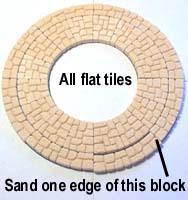
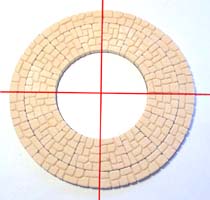
| 1. | The building plans will have a full-size layout that you can place the blocks directly on. Start by gluing the floor tiles together but don't glue them down to the layout! We will need to use this layout sheet several more times. The outside ring of tiles will be a little large, so sand one of the ends and it will fit correctly. |
 |
 |
|---|
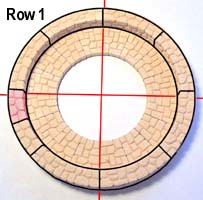
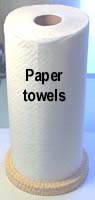
| 2. | Here's row 1. Do not glue the block shown in red! This block is used to hold the place of the doorway and it will be removed once the glue dries. To help keep the tower round, place a roll of paper towels inside of the tower. You may to remove a few sheets to get the diameter small enough to fit. As you assemble and glue the remaining rows, leave the paper towels in. This will help all of the rows line up and keep your tower circular. |
 |
 |
|---|
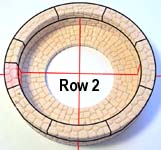
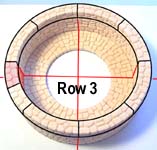
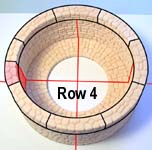
| 3. | Leave the paper towels in while you're gluing the rows on. Here's row 2, 3 and 4. The blocks shown in red are small blocks used to hold the place of the doorway. These blocks will be removed once the glue dries. |
 |
 |
 |
|---|
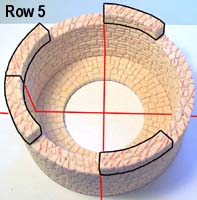
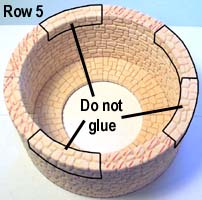
| 4. | Here's row 5. Only glue down the blocks in the first photo. We want this tower to come apart in sections, so we will only glue certain blocks. I drew lines on these blocks with a marker to remind me not to glue any blocks to this surface. Complete row 5 by setting the blocks on but do not glue them down! |
 |
 |
|---|
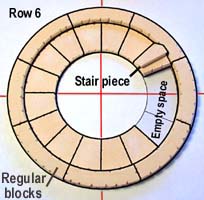
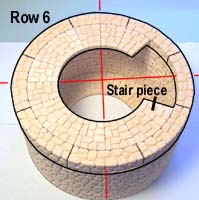
| 5. | We're going to assemble row 6 upside down. Glue these blocks together but not to the layout sheet. Make sure this row is completely dry before you try to move it. Flip this row over and glue it onto the tower but do not glue where the marked lines are! Remember, you want to remove this section later on. |
 |
 |
|---|
| 6. |
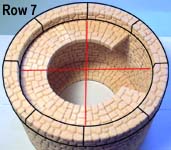
Row 7 is pretty simple. Just glue the blocks down as the photo shows. |
 |
 |
|---|
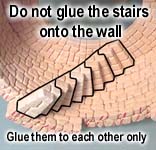
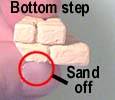 Remove row 6. Lay the tower on its side. Glue 5 step pieces together but do not glue them to the wall! We'll glue the stairs into position after we paint the model.
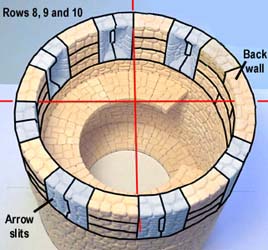
| 7. | Here's row 8, 9 and 10. The arrow slits are shown in blue.
|
 |
|---|
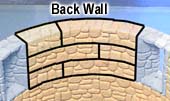 Here's a photo of the back wall. I added it here so you can get a good look at what blocks make up this solid area. It needs to be solid because a staircase will eventually go here.
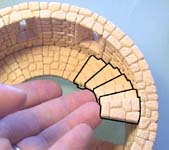
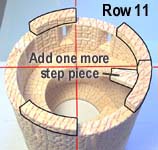
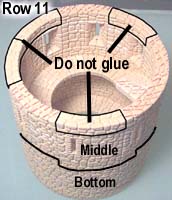
| 8. | This part takes a lot of patience. Glue the step blocks in as shown. You will have to hold them in place until they dry, about 5 minutes. Be sure the top of each step section lines up with the top of each row. Then glue on row 11 and mark the blocks (and step piece) as shown. This will remind you where not to glue for the next row. |
 |
 |
|---|
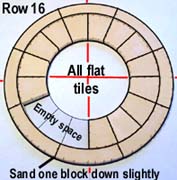
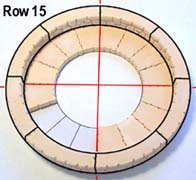
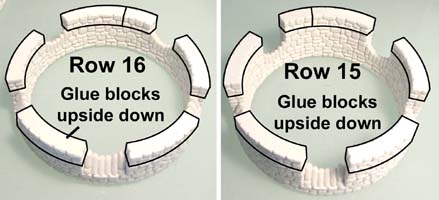
| 9. | For the final levels of the tower, we'll work from the top down starting with row 16. Glue these flat blocks together upside down, but not to the layout sheet. Sand the edge of an outside block to make the outside circle slightly smaller, just like we did in step 1. Add row 15 with the blocks upside down as the photo shows. |
 |
 |
|---|
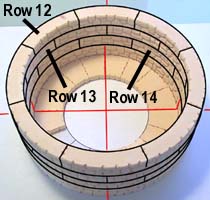
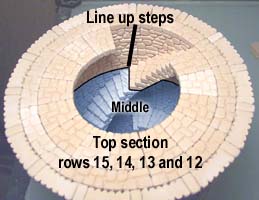
| 10. | This photo shows row 14, 13 and 12. Just glue the blocks in an alternating pattern like you have been doing. Also be sure that you're gluing the blocks on upside down as the photo shows. Let this section dry completely! Once dry, we will have to turn this section onto its side to put the stairs in. |
 |
|---|
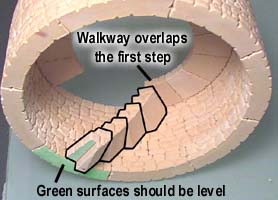
| 11. | Place the tower on its side with its smooth surface facing you. Glue 4 step blocks inside the tower, making sure that the first step gets overlapped by the walkway tiles as shown in the photo. Be sure that the last step gets positioned so that the green surfaces are level with each other. This will ensure that the stairs will seamlessly mesh with the tower section below. Let the steps dry completely! |
 |
|---|
| 12. | Lay the tower section down again (rows 15-12). Place an alternating ring of large and small teeth around the outside of the tower. Here's where I screwed up. The teeth should have lined up perfectly, but instead there are gaps on one side. I was sure they lined up correctly while testing the pieces.
Now break another small tooth section into thirds as the small photo shows. Use a hobby knife to trim down any excess. Place the middle third from one tooth block in between the two halves of the first tooth block to fill the gaps in that section. |
|---|
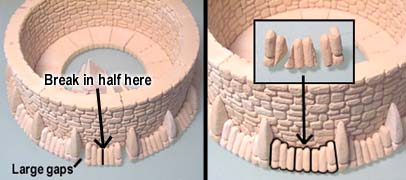 This is fairly easy to fix. Take one of the small tooth sections and break it in half. This is easy to do just using your hands.
| 13. | This part is very tricky. Remember row 11? We had glued a few blocks down, but hadn't completed the row. Place blocks down to fill up the row but do not glue them down! Temporarily set the top section on so that the stairs join together properly. |
 |
 |
|---|
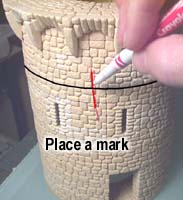
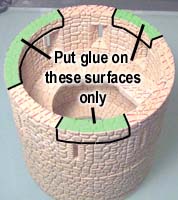
| 14. | Using a marker, draw a line down the side. This will help you line up the sections quickly once you apply the glue for the final fit. Apply glue to the loose blocks on row 11 only. Now set the top section back on so that your mark lines up. This will glue the loose blocks to the top section and the steps should line up. |
 |
 |
|---|
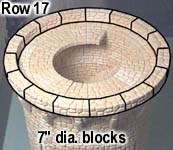
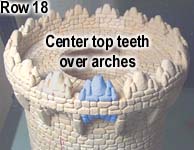
| 15. | Now that the top is back on the tower, glue row 17 on. It's a ring of 7" blocks. Row 18 (the very last row), uses the top decorative teeth for the crenellations. I centered these teeth over the arches, but you can space them out as you like. |
 |
 |
|---|
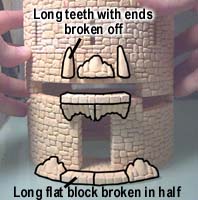
| 16. | The door dressings are optional. You don't have to add them if you would prefer a simple opening in your tower. The bottom is a flat tile snapped in half along with two top decorations. The long teeth on the top have the ends broken off so they're not quite so long. Also take note on which section of the tower these pieces are glued to. |
 |
|---|
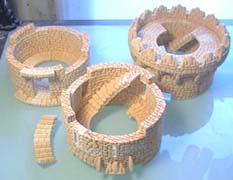
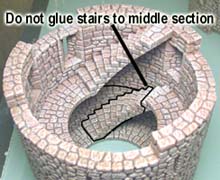
| 17. | To paint the tower, look at the Earth Tone Painting Instructions page. After you paint the tower, glue the stairway to the bottom section of the tower. Be sure you don't glue it to the middle section or you won't be able to get the tower apart again. |
 |
 |
|---|
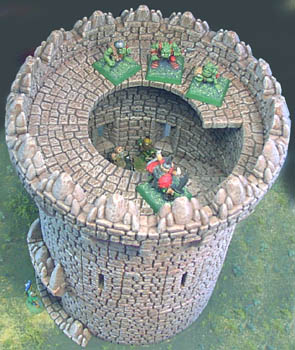
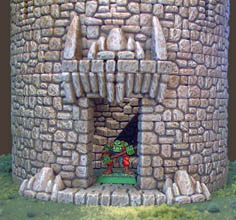
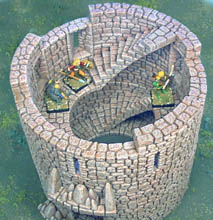
Here are a few photos of the finished tower. The first photo shows a close-up of the doorway. The second photo is what the inside of the tower looks like when you remove the top section. If you like, you can use the floor tiles from mold #72 to fill in the roof, so you don't have a hole in the center. The orc figures are from Games Workshop(TM). The other figures are from Holistic Design(TM). |
 | |
 |
 | |
Building a Tower with a Conical Roof
You will need to 28 castings from mold #73 to have enough blocks to build the circular tower. This version takes more castings because this tower has more rows of blocks. Be sure the blocks are completely dry before gluing them together.
You will also need 12 castings of mold #86 for the wood shingle roof.
You can download the plans shown here from the Building Plans Page and print them out yourself. You'll want the plans labeled "6" Circular Fieldstone Plans". We will follow these plans until we reach step 8 in the instructions below. After that, we will no longer follow the paper plan.
| 1. | The building plans will have a full-size layout that you can place the blocks directly on. Start by gluing the floor tiles together but don't glue them down to the layout! We will need to use this layout sheet several more times. The outside ring of tiles will be a little large, so sand one of the ends and it will fit correctly. |
|
|
|---|
| 2. | Here's row 1. Do not glue the block shown in red! This block is used to hold the place of the doorway and it will be removed once the glue dries. To help keep the tower round, place a roll of paper towels inside of the tower. You may to remove a few sheets to get the diameter small enough to fit. As you assemble and glue the remaining rows, leave the paper towels in. This will help all of the rows line up and keep your tower circular. |
|
|
|---|
| 3. | Leave the paper towels in while you're gluing the rows on. Here's row 2, 3 and 4. The blocks shown in red are small blocks used to hold the place of the doorway. These blocks will be removed once the glue dries. |
|
|
|
|---|
| 4. | Here's row 5. Only glue down the blocks in the first photo. We want this tower to come apart in sections, so we will only glue certain blocks. I drew lines on these blocks with a marker to remind me not to glue any blocks to this surface. Complete row 5 by setting the blocks on but do not glue them down! |
|
|
|---|
| 5. | We're going to assemble row 6 upside down. Glue these blocks together but not to the layout sheet. Make sure this row is completely dry before you try to move it. Flip this row over and glue it onto the tower but do not glue where the marked lines are! Remember, you want to remove this section later on. |
|
|
|---|
| 6. |
Row 7 is pretty simple. Just glue the blocks down as the photo shows. |
|
|
|---|
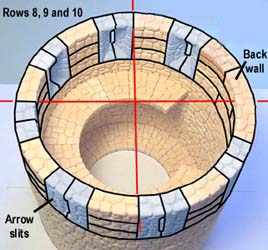
| 7. | Here's row 8, 9 and 10. The arrow slits are shown in blue. All of the arrow slits have 1/2 blocks between them, except when you get to the back wall. The back wall has more space between the arrow slits, so you'll need a full block and a half block to fill this space. The reason for the large space between the two back arrow slits is that we need to fit our staircase on that back wall. |
 |
|---|
| 8. | This part takes a lot of patience. Glue the step blocks in as shown. You will have to hold them in place until they dry, about 5 minutes. Be sure the top of each step section lines up with the top of each row. Then glue on row 11 and mark the blocks (and step piece) as shown. This will remind you where not to glue for the next row. |
|
|
|---|
After you complete row 11, we will no longer be following the printed plans to complete the top of the tower. Instead, follow the block-by-block instructions listed below to finish the very top of the tower. |
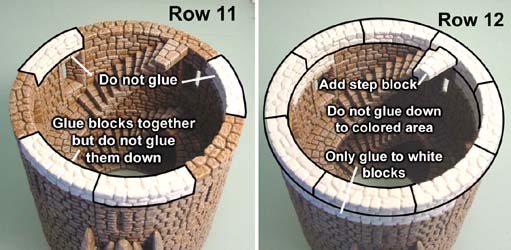
| 9. | Place blocks to finish row 11. Do not glue these blocks down to the colored area. Next glue a full row together but only glue them to the white blocks! Do not glue them to the colored area or you will not be able to lift off the top of the tower. Also add one step block. |
 |
|---|
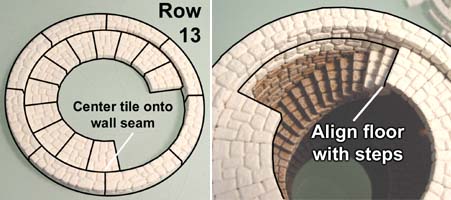
| 10. | Row 13 is a ring of blocks with 12 floor tiles in the center.
Center the bottom floor tile over the seam in the wall blocks. Let these dry completely. Glue this row onto the tower so the floor tiles act as the top stair. |
 |
|---|
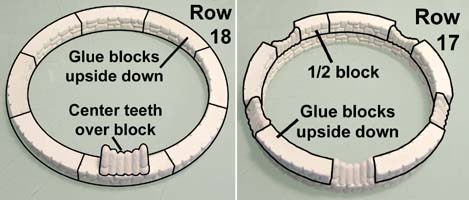
| 11. | For this next part, we're going to skip up to Row 18. Glue this ring upside down and center a tooth block over one of the blocks. For Row 17 (we're working upside down), alternate teeth and regular blocks all around. At the back you will need a 1/2 block to fill the remaining space. |
 |
|---|
| 12. | Continue gluing blocks upside down for the following rows 16 and 15. |
 |
|---|
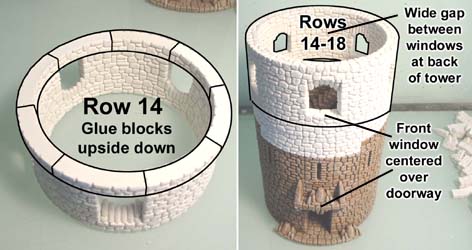
| 13. | Finish the window section by adding Row 14. Let this window section dry completely. Once dry, turn the window section right side up and glue it onto the top of the tower. Be sure to center the front window over the door and position the large gap between the two back windows at the very back of the tower. |
 |
|---|
| 14. |
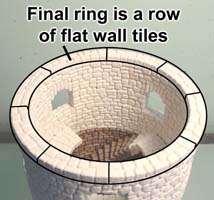
Let this tower top dry completely! Next we will flip the tower top upside down so we can place the decorative teeth around the outside. |
 |
|---|
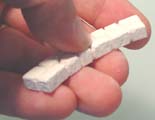 Finish off the very top of the tower by adding a row of flat wall tiles. These are the blocks that are the same thickness as the floor tiles.
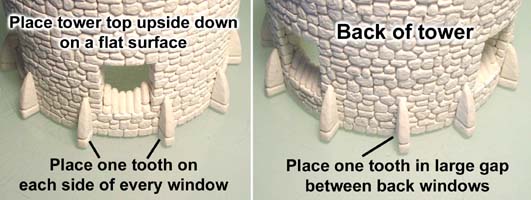
| 15. | Place the tower top upside down and glue one tooth on each side of every window. At the back of the tower, glue one extra tooth where there is a large gap between the windows. |
 |
|---|
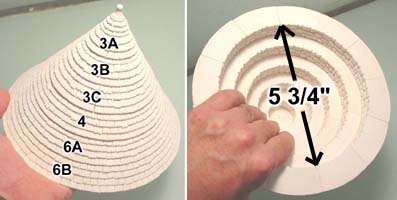
| 16. | Assemble a 6" wood shingle roof using mold #86. You will need to cast the mold 12 times to make this roof. For information about the conical roof, visit the Conical Roof Building Instructions page. Once assembled, the inside of the roof will measure about 5.75" across, which is just a little smaller than the outside diameter of the completed tower. |
 |
|---|
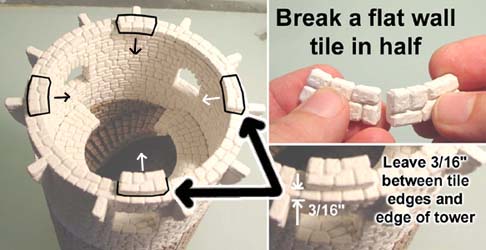
| 17. | I'm going to glue blocks on top that the roof will nest into. Break two of the flat wall tiles in half and glue them to the top of the tower. Pull them in towards the center so you leave 3/16" between the outside wall and the blocks. |
 |
|---|
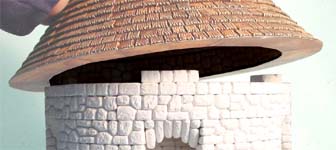
| 18. | Before the glue dries, be sure that your roof will set down flat over the blocks and there is not too much room for it to side around. The inside rim of the roof is slightly smaller than the outside of the tower. These small blocks will nest inside of the roof and hold it in place. |
 |
|---|
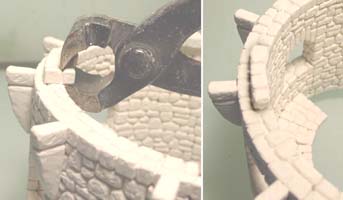
| 19. | I didn't care too much for the look of the blocks overhanging the edge, so I used a pair of nippers to chip away the extra edge. Now the edge looks a little more natural when you see the tower with the roof removed. |
 |
|---|
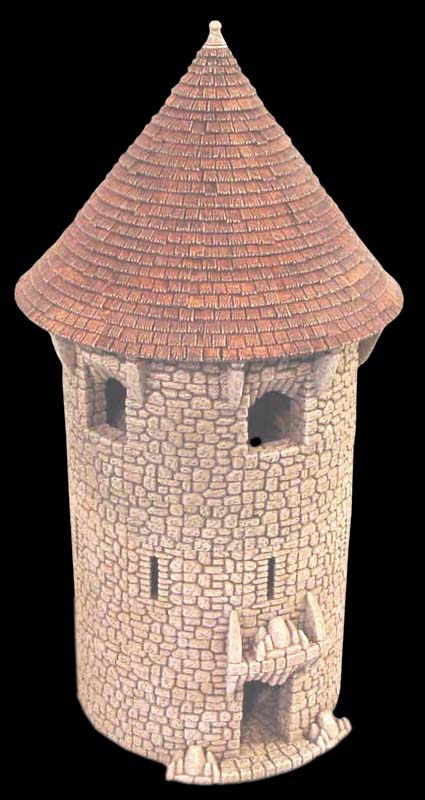
| 20. | For instructions and colors used to paint the tower, refer to the Earth Tone Painting Instructions page. For instructions on painting the wood shingle roof, visit our Conical Roof Painting Instructions page. Click on the photos for a larger view of the tower. |
 |
 |
|---|